

#21: Slop 🐷
When the bottom of the barrel is lower than you thought


In 2022, full of post-Covid optimism (sweet summer child that I was), I wrote that B2B tech marketing was *thisclose* to hitting rock bottom. The old tactics didn’t work anymore, people were tired of being harvested like corn on lead gen forms, Covid had reawakened in us the desire for real human connection again. We were positioned for a renaissance, and marketers and C-suites leaning into it would change everything for the better.
Then AI asked us all to hold its beer.
Last month I wrote about how content marketers can move one step at a time when it comes to navigating AI. But today I’m plunging off the cliff I deliberately talked about avoiding last time. It’s not that I don’t believe what I said — for companies and marketers who can focus on the right things, AI is a powerful tool.
The problem comes when we let it drive the strategic bus, and I see some disturbing patterns that suggest that’s the way marketing is headed before the phoenix rises from the ashes.
The reality today is far worse than I imagined a couple of years ago. My LinkedIn feed is full of promotional, AI-generated garbage. Pure slop. I have to scroll past “thought leadership” by people profiting from AI telling me that I should learn how to develop agents at all costs and I will not succeed if I don’t. I don’t see people I like anymore on my feed, mostly because they don’t want to pay for premium either, and the algorithm today is dedicated to making your life hell if you don’t.
This is where the bottom gets deeper, and it raises a bunch of questions I don’t really want to be asking (like, what if I do have to build a bunch of agents as a marketer just to stay competitive? Will deep SME knowledge in this be table stakes for any future marketing leadership role? When bots leave comments on other bots’ posts, does the death of my hopes and dreams make a sound?)
I think of all the reasons I got into marketing in the first place, most of which involved building relationships, not prompts or agentic workflows.
I’m guessing there is a non-zero chance that the dread you feel, like mine, when you open your computer, turn on a podcast, open the social media app of your choice, etc. is exhausting. If you’re like me, you might be seeing all of this in front of you and you have to keep pushing back the thought that keeps creeping up in your head:
THIS IS NOT WHAT I WANTED.
So… what now?
💪 Actionable Tip: Remember who’s boss
AI is just one more battlefield for sound marketing practice, which is the point of all of the drums that I bang on consistently and have been for longer than I’ve known what a GPT is.
What buyers need hasn’t changed since my naive post of 2022 — they do need connection and empathy and respect. They are sick of forms and gates. They’re flocking to ChatGPT because Google has served them more ads than answers. They don’t follow your company account because they’re tired of being sold to.
What’s changed for the worse in every regard is our side of the equation:
Businesses post-ZIRP are increasingly obsessed with AI-fueled efficiency to appease their investor overlords, forgetting that effectiveness matters much more
Tech giants have finally stopped pretending that the internet is about “connection” and are treating it as the full cash grab it is (see Google and LinkedIn algos above; they’re operating just as designed 💰💰💰)
Entire cottage industries have sprung up around AI, taking marketers’ money and promising the short-term new hotness instead of the foundational elements that any tool adoption should be based on. One’s a lot easier to profit from than the other.
We’re in such a reactive state right now that no one is talking about what actually works. Marketers (and their bosses and their bosses) are so scarcity-minded that the focus becomes “catching up” to a future no one can see instead of putting effort into resonating with buyers.
There is a difference between intentional, strategic AI adoption and unexamined shiny object syndrome based on existential fear.
If your business is missing core foundational pieces like an awesome product, differentiated positioning, clear messaging, and deep buyer understanding not from Claude’s read of your Gong calls but from face-to-face conversations with customers, you do not need to go down the rabbit hole of agentic workflows.
The last thing you need is to do the wrong things faster. You need to get back to basics, put the customer first just like you should, and do the work.
I still believe that. The question is if the market will allow us to do the right thing. And that’s where I think many of us are stuck.
💡 Big idea: Let’s go outside
I’m skipping my usual Anti-Pattern section because everything we see is an anti-pattern right now.
Instead, let me share a bit with you about where I’m at personally.
I’m 43 years old, which is mid-everything: mid-career, mid-life, mid-parenting a teenager who tells me that I’m using “mid” wrong.
I was very wrong in 2022 about the nadir of B2B marketing being close, which means that the comeback is postponed indefinitely. I’ve been around long enough to see everything leave and come back again, from wide leg jeans (yay!) to Pamela Anderson (huh!) to unironic mustaches (boo!).
I don’t believe in the “death” of anything, but I do think things will probably get worse in our industry before they get better. The question I’m wrestling with today, in all my “mid," is how long do I want to wait?
It’s hard to have these conversations on LinkedIn or in Slack channels dedicated to “doing the work.” You come across as a bit of a Debbie Downer, and that’s only if the right people see your posts anyway.
Give me the digital equivalent of touching grass.
I need more of a real connection with others who are struggling with the same thing, whether that means navigating what marketing means in 2025 or navigating a different path.
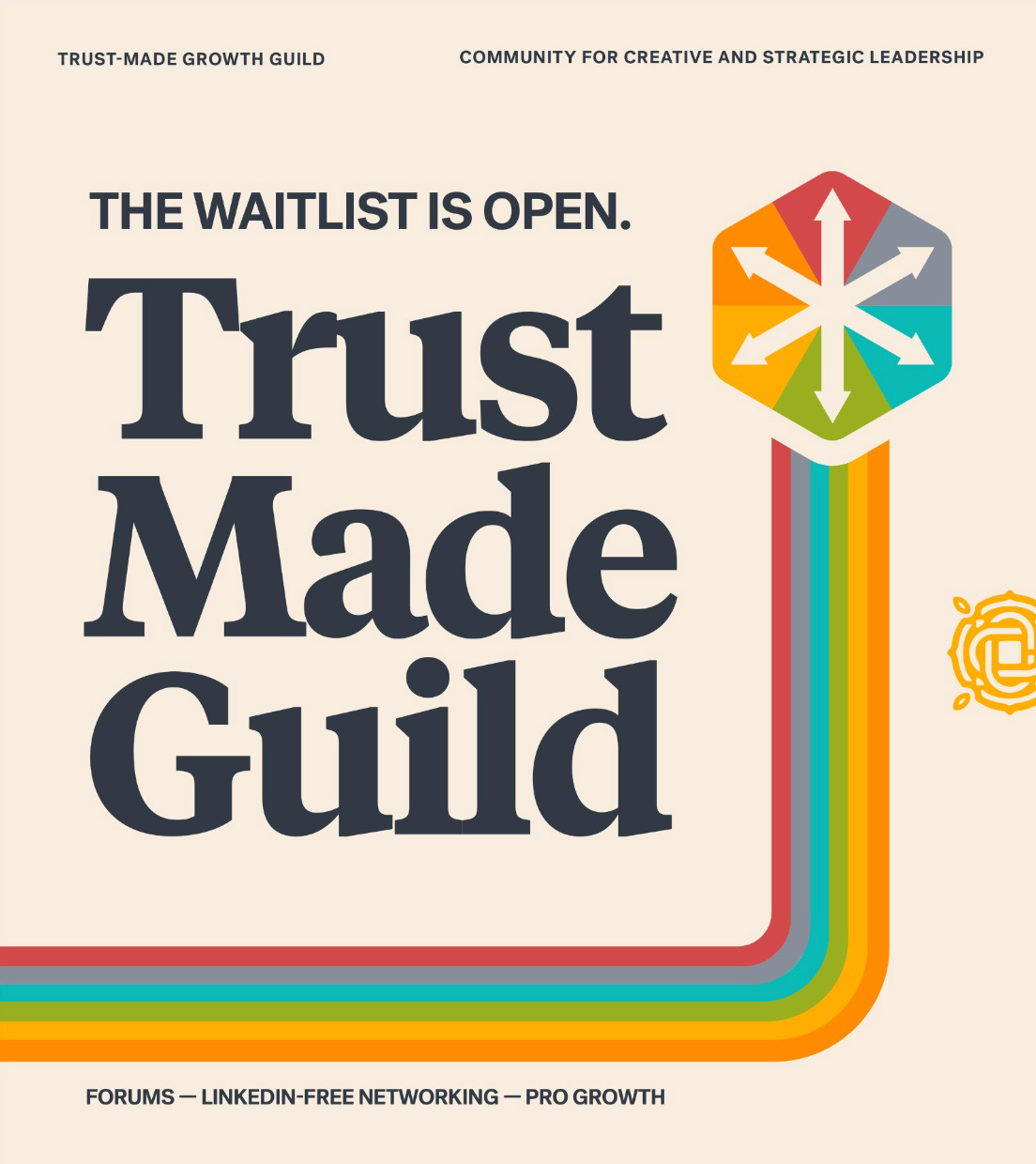
So I’m joining Culture Craft’s new (free!) community, the Trust-Made Guild.
Nick and I connected several years ago when I reached out to him in an existential panic about marketing being undervalued in my organization. He is a born teacher, and CultureCraft's courses and networking groups have been a huge source of professional development as I've grown in my career.
If any of what I’ve written here today feels resonant, I’d love to see you there.
Yours in contention,
Lauren