

#23: The Break-Up
How to stop working with people who waste your time


I once spent a full year trying to get a VP of Sales to participate in content creation.
My eyes roll back in my head even now thinking about it. Twelve months of doing the “hey, just circling back” dance. Our shared Slack DMs looked like those screenshots of unhinged stalker texts that end up on Netflix true crime documentaries (and horrifyingly, the stalker was me). Question after question that went unanswered, ping after ping to join a standing call that he honored maybe 25% of the time.
Looking back, I was operating under the assumption that I needed his input and sign-off. I thought that it was my job to convince everyone, convert everyone, make everyone care about content. Sales most of all!
And I tried, and still do. My last edition here was all about that.
But it’s also important to remember that your content kingdom is your chess board. You get to decide how you’re going to play the game and (to an extent) who you invite to play with you.
Not every stakeholder is a good one, and woo boy, there are some real clunkers out there. But most of the time, you can stop working with the bad ones. Let me show you how.
💪 Actionable Tip: Map Your Stakeholder Board
Before you can decide who deserves your energy, you need to see the full picture of who you’re working with and what they’re actually bringing to the table.
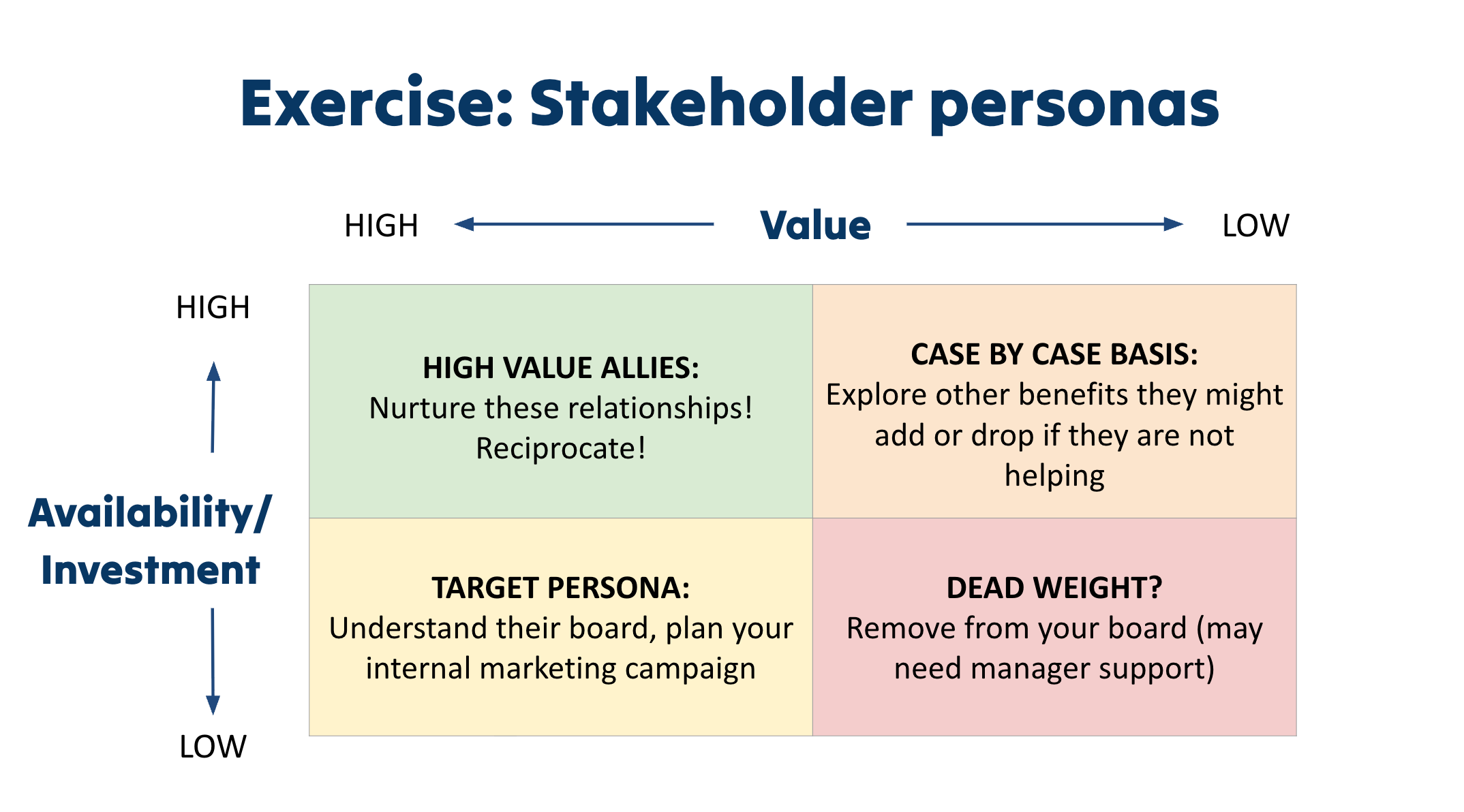
Here’s an exercise I run with content teams: create a 2x2 matrix with two axes.
Value (horizontal axis): How much value do they add to your work? How much knowledge or expertise are they capable of contributing? How much do you actually want them involved?
Availability/Investment (vertical axis): How accessible are they? How engaged are they when you do work together?
Now plot every stakeholder you currently work with (or are supposed to work with) somewhere on this grid — and be honest. You’ll end up with four quadrants:
High Value, High Availability = Your Allies
These are your dream collaborators. They respond quickly, they show up prepared, they care about the work. Guard these relationships with your life. Reciprocate their energy. Thank them publicly and ask how you can support their work. At the very least, buy them candy or puppies.
High Value, Low Availability = Your Target Personas
These folks have the expertise you need, but they’re stretched thin or not yet convinced that content is worth their time. This is where your internal marketing efforts should focus. What are their priorities and OKRs? Plan your campaign to convert them from “too busy” to “this is actually helping me hit my goals.”
Low Value, High Availability = Case by Case Basis
Willing to help, but maybe they lack the deep expertise you need, or they're in a role that doesn't move the needle for content success. Explore whether they could add value elsewhere. Maybe they're better at distribution than creation, or helpful for feedback but not ideation. Use them strategically where they actually shine.
Low Value, Low Availability = Dead Weight
Here’s where it gets interesting (bwahaha). These are people who neither contribute meaningfully nor show up consistently, even if on paper they’re VIPs like subject matter experts or executives. They’re blockers. They’re consistently unhelpful. They offer feedback 10 minutes after you hit publish instead of the 10 days before when you needed it. They drain your energy and give nothing back.
Congrats! It’s time to take their game pieces and tell them it’s time to go home.

Figuratively, of course.
I definitely don’t recommend storming into someone’s office and firing them from content. Instead, it’s more like “quiet quitting” on them. Stop asking them for signoff or SME time, stop waiting for their input, take them off the calendar invites. Redirect your energy to people who actually want to be there.
🚫 Antipattern: Trying to play fair
The biggest mistake content marketers make with stakeholder management is treating everyone the same.
We try to win over both the executive who’s never opened a content doc and the product manager who’s been our champion since day one because we’ve been taught that being “collaborative” means being available to everyone. If someone’s not engaged, it’s our job to figure out how to engage them and we’re just not doing it right.
But what this actually creates is exhaustion and resentment. We end up spending 80% of our time chasing ghosts while neglecting the 20% who are already our early adopters.

They’re your coworkers, not your kids. You’re allowed to play favorites.
The people in the dead weight quadrant aren’t going to suddenly care just because you try harder. Some people fundamentally don’t believe content matters. Some are checked out of their job entirely. Some are useless because their priorities are genuinely elsewhere and content creation is just never going to make the list.
That’s not a reflection on you or me. It’s just reality, and that’s okay.
But when we continue to spend time and energy on people who consistently don’t show up or add value, we’re making choices about where our finite resources go.
Why not invest them somewhere we’ll get better returns?
Bending the Spoon teaches content marketers to think like leaders by proving the value of their work. I’ll show you how to use data to correlate content to pipeline, how to communicate successfully with executives, and how to build cross-functional relationships that make you an MVP in your organization.

💡 Big Idea: Firing Stakeholders Is Strategic
Every hour you spend chasing someone who doesn’t want to be caught is an hour you’re not spending on someone who does.
When you make intentional decisions about who gets your attention, you’re being strategic about how to drive the most impact for your content program. Think about it like you would a backlog of content projects. You'd evaluate them based on potential impact, effort required, and strategic alignment. You wouldn't just work on everything because it exists on a list.
Stakeholder relationships work the same way.
Sometimes I get pushback, and that objection I place directly into the “you f’ed around and found out” file. Someone might notice they’re not being included anymore and ask why. This is where I get honest (but diplomatic): “I’ve been trying to find a time that works for your schedule and haven’t been successful, so I’m moving forward with folks who are more available. But I’m happy to revisit if we can come up with a process that works better.”

If you need manager support for this conversation, then loop in your manager. A good boss will back you up on focusing your time where it matters.
SO MANY good things happen when you do this:
Your work gets better and faster. You’ll have fewer cooks in the kitchen (you need less than you think) and don’t have to build in extra time waiting on flaky stakeholders to respond.
You’re less frustrated because you’ve stopped hinging the success of the next content piece on someone with all the reliability of a juice-drunk toddler.
Most importantly, you’re modeling a professional boundary that you’re here to do great work with people who want to do great work with you — and you mean business.
I eventually stopped trying to work with that VP of Sales. And you know what happened? Nothing. The world didn’t end. Our content program didn’t collapse. In fact, it got better.
I redirected that energy to AEs who actually wanted to collaborate, and one of them became one of my biggest allies. She shared our content religiously, proactively reached out to ping me on customer insights that informed our strategy, and made my job easier.
You can’t force people to value content. But you can choose who gets to create it with you.
Choose wisely.
Yours in contention,
Lauren